Whether it be at the professional level or the collegiate level you cannot tell the history of sports without mentioning civil rights. One of the most influential civil rights leaders was Jackie Robinson, often mentioned in the same breath as Martin Luther King Jr, Malcom X and Rosa Parks. Athletics and civil rights go hand in hand together. Sports pushed civil rights forward in many ways. Most sports were segregated until the post war period. Black athletes experienced racism and segregation on and off the field once sports were segregated. Sport always challenged and pushed the limits of segregation. Black men could compete in sports and it really was the best option for them to rise to success in society in the 1950s and 60s. In this essay I will examine 3 case studies of sports and civil rights from the period of 1939 to 1966. Jackie Robinson at UCLA, Loyola footballs forfeit of a game against Texas Western in 1950, and the Texas Western basketball team in 1966. In the case of UCLA and Texas Western they accepted black athletes into their universities because they could benefit their athletic programs. Loyola University accepted black athletes to improve their athletic program as well. However, Loyola showed that they cared about their athletes off the field and stood up for their players basic human rights. All three of these examples tie in together and play a crucial part in understanding the complexities of civil rights in America.
Jackie Robinson’s athletic career is well known. He truly was a great athlete but his legacy in American history is not as much about his play on the field as it is about breaking the color barrier in Major League Baseball. What often gets overlooked is Jackie Robinson was a path breaking athlete at UCLA. Jackie Robinson playing in the MLB was monumental but people often forget he played 4 sports at UCLA in the year 1939. Los Angeles was a fairly progressive city when it came to civil rights. The fact that Jackie Robinson was able to play 4 sports and even enroll at UCLA in 1939 expresses that. This does not mean that UCLA was a model for social justice and should be commended for how they treated their black students however. Black students were restricted in almost every way on campus and were not really allowed to do anything outside of class that the campus had to offer. The following is a quote from a book titled Jackie Robinson written by Arnold Rampersad about Jackie’s time at UCLA “As usual black athletes had it the hardest. They could not live in the village of Westwood; they were also not expected at any socials or student parties and certain jobs, such as work in the campus store were also denied to them. And there were no black professors or instructors as the university. Still In comparison to many other places UCLA was a friendly place for the black student, and the gifted black athlete was welcome.” (page 67) Jackie Robinson was valued at UCLA because of his athletic ability. Black athletes were allowed to attend big universities because these universities exploited these athletes for their talent. Big sports schools across the country also accepted these athletes strictly to exploit their talent. There were rewards to be had by accepting black athletes. The reward was an improved athletic program which translates to wins and money. These athletes were accepted into schools at this time period but this by no means meant racism had gone away at these schools. Racism was still present at these schools even if segregation wasn’t.
In 1950 then Loyola University (Loyola Marymount University following the merge with Marymount college in 1968-1973) was scheduled to play against Texas Western College in a football game. LMU had three black players and a black trainer on the team. It was not uncommon for black athletes to compete and attend colleges in California. In 1950 black athletes or black people in general still faced segregation in a progressive city like Los Angeles. In Los Angeles the racism was not as overt. There was de facto racism in Los Angeles similar to what Jackie Robinson experienced at UCLA. It affected their daily lives but in Texas there was legal racism and segregation. There were massive differences in how the State of California and the state of Texas treated black people in the 1950s. Nonetheless a game had been scheduled between Loyola University and Texas Western. Red Hopkins is a central figure in this story. He was the LMU football team manager. He had the responsibility of making the accommodations and scheduling games. He was responsible for scheduling the Texas Western game and he also made the hotel reservations at the Hotel Cortes for the team to stay at. Loyola University was put in a tough situation by the fact that the Hotel Cortes would not allow black players to stay there. The Hotel Cortes said they would make accommodations for the athletes to stay elsewhere in the city but under no circumstance could stay at the hotel. In addition, there was a standing rule in the state of Texas that prohibited black athletes from playing as detailed in the LMU Magazine story about the game titled “No One Left Behind” “The Board of Regents of the University of Texas, of which Texas Western was a member, would not budge from its longstanding rule that blacks could not play for or against football teams in its division.” This rule plus the black athletes not being able to stay at the same hotel as the rest of the team was not sitting well with members of Loyola’s team, athletic program and Faculty.
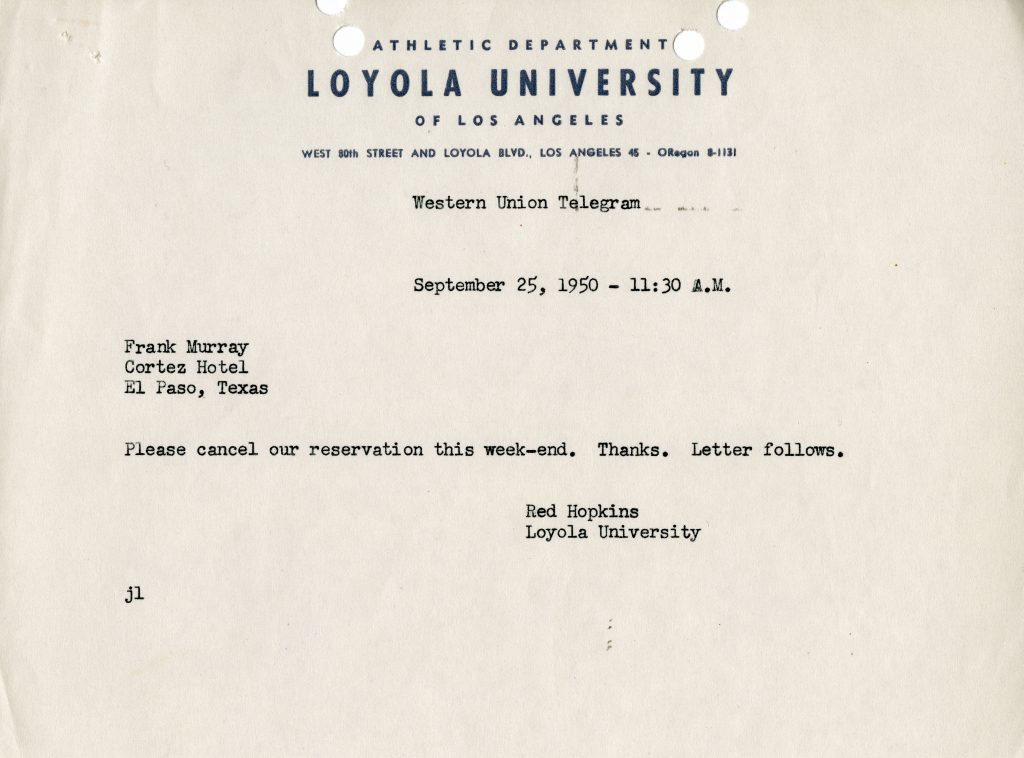
Loyola University had to decide whether to play in this game without their black athletes and trainer being able to go. Loyola University stood by their Jesuit values when it came to defending the black players and trainer. Loyola was and still is a Jesuit university. The following is a part of the LMU mission statement “we invite men and women diverse in talents, interests, and cultural backgrounds to enrich our educational community and advance our mission the encouragement of learning: the education of the whole person, the service of faith and the promotion of justice.” A core tenant of Jesuit values is social justice and ethics. Justice is not giving into what is easy but is rather doing what is fair and right. It would not seem ethical to play in this game just for money and the success of an athletic program. The Jesuit mission is about more than that. Doing what is right and ethical is above all else. From a Jesuit university perspective, it would be unethical to take part in this game. It is not a simple decision though because if you cancel the game you lose money and it also looks bad for your football program. The hotel was already booked for the whole team as well as airfare. In a situation like this a school can show what is truly values. Loyola showed above all else they truly believe in their Jesuit values. The following is a direct quote from Red Hopkins to the Hotel Cortes in El Paso dated September 25th,1950 weeks before the game “Please cancel our reservation this weekend. Thanks.” By canceling their reservation, they canceled the trip to El Paso. This was the first step in forfeiting the game against Texas Western. Loyola did not stand for segregation and stood up for their black athletes and trainer. According to the article from the LMU magazine the school lost roughly 10,000 dollars in all just from forfeiting this game. It also was harder for Loyola to schedule games with other teams going forward. Knowing a team canceled a game within a season unsettling to some schools. Red Hopkins had trouble getting scheduled to play games outside the state of California. All the players and coaches supported the decision which was ultimately made by Loyola University president Charles Casassa. Loyola suffered financially and athletically from this decision. They placed their Jesuit values above winning.
Sixteen years after Loyola University forfeited a game against Texas Western because of segregation, Texas Western Ironically became the first team to start an all-black lineup in college basketball history. Not only were they the first team in college basketball to start five black players but they also won the National Championship that year beating a historically great Kentucky basketball team coached by Adolph Rupp. Pat Riley who went on to play in the NBA and become one of the best head coaches in NBA history, also played on the Kentucky team in 1966. Kentucky was a team of all white players and was a perennial blue blood in college basketball. Texas Western was unheard of in college basketball. If a school like Texas Western could be Kentucky with 5 black players against 5 players it would be groundbreaking for black athletes across the country. At the time of the game Riley didn’t realize how meaningful that game was for black athletes across the country. To Riley at the time it was just a heartbreaking loss with not much historical significance. The following is a quote from Pat Riley in a book about the game titled The Night They Drove Old Dixie Down, “When he came to the Lakers, Bob McAdoo told me how much the game meant, how it changed everything, how it opened up the world for black kids in the South,” says Riley. “I guess I never really thought of it that way, that we were such a big part of history. The loss remains. I’ve never felt emptier. It was the worst night of my basketball life, but I’m proud to have taken part in something that changed so many other people’s lives.” The fact that Texas Western was able to win on such a massive stage had huge ramifications for black athletes all over the country. From a talent perspective other schools started recruiting more and more black players. If teams didn’t recruit black players they would not be able to keep up with teams like Texas Western. Secondly it was an inspiration to young black kids across the country. It showed them that a group of black players could come together and succeed and that ultimately their talent could be appreciated and succeed at the top level. The fact that they beat a blue blood program like Kentucky shows the significance and importance of the game. It showed that black athletes could not be turned down and discriminated against much longer.
The case studies of Jackie Robinson, LMUs football team and Texas Western’s basketball team are all significant stories in college athletics and each case study advance rights for black athletes in some way. In the case of Jackie Robinson, he played 4 sports in as a black athlete in 1939. Loyola showed in 1950 that a school was willing to stand up for their black athletes against segregation. Texas Westerns basketball program was probably the most significant. It showed a team of 5 black athletes could win a national championship. What still can be questioned about these case studies is whether they helped to progress rights of black athletes outside of sport. In the case of UCLA, we see that they were progressive in 1939 for allowing Jackie Robinson to play 4 sports. However, his rights as a person off the field were restricted. Texas Western made history becoming the first school to win with 5 black players in the starting lineup. Their coach believed this gave the team the best chance to win and he supported his players. This should be commended but this didn’t necessarily help these players off the court. UCLA and Texas Western did not sacrifice their athletic programs in any way to improve their black athletes rights off the field. That’s why the LMU example stands out because they sacrificed wins. They gave up money and damaged the future of their football program for standing up for what was right. Their black players could physically see that the people at the University cared about them and wanted to better their lives off the field. Sport in America is a vehicle in which African Americans in an era of Jim Crow laws and segregation could rise above. It really was one of the only outlets for African Americans which is sad. The story of Civil Rights in America cannot be written without sports as a central part.
Written by: Brennan Campbell, History, 2021
For Further Readings
Smith, A. (2017). No One Left Behind. [online] LMU Magazine. Available at: https://magazine.lmu.edu/articles/no-one-left-behind/ [Accessed 12 Oct. 2019].
Rampersad, Arnold. 1997. Jackie Robinson : A Biography. Knopf.
Kirkpatrick, Curry. 1991. “The Night They Drove Old Dixie Down In 1966, an All-Black Lineup from Texas Western Beat All-White Kentucky for the NCAA Title. College Hoops Hasn’t Been the Same since.” Sports Illustrated 74 (12): 70.